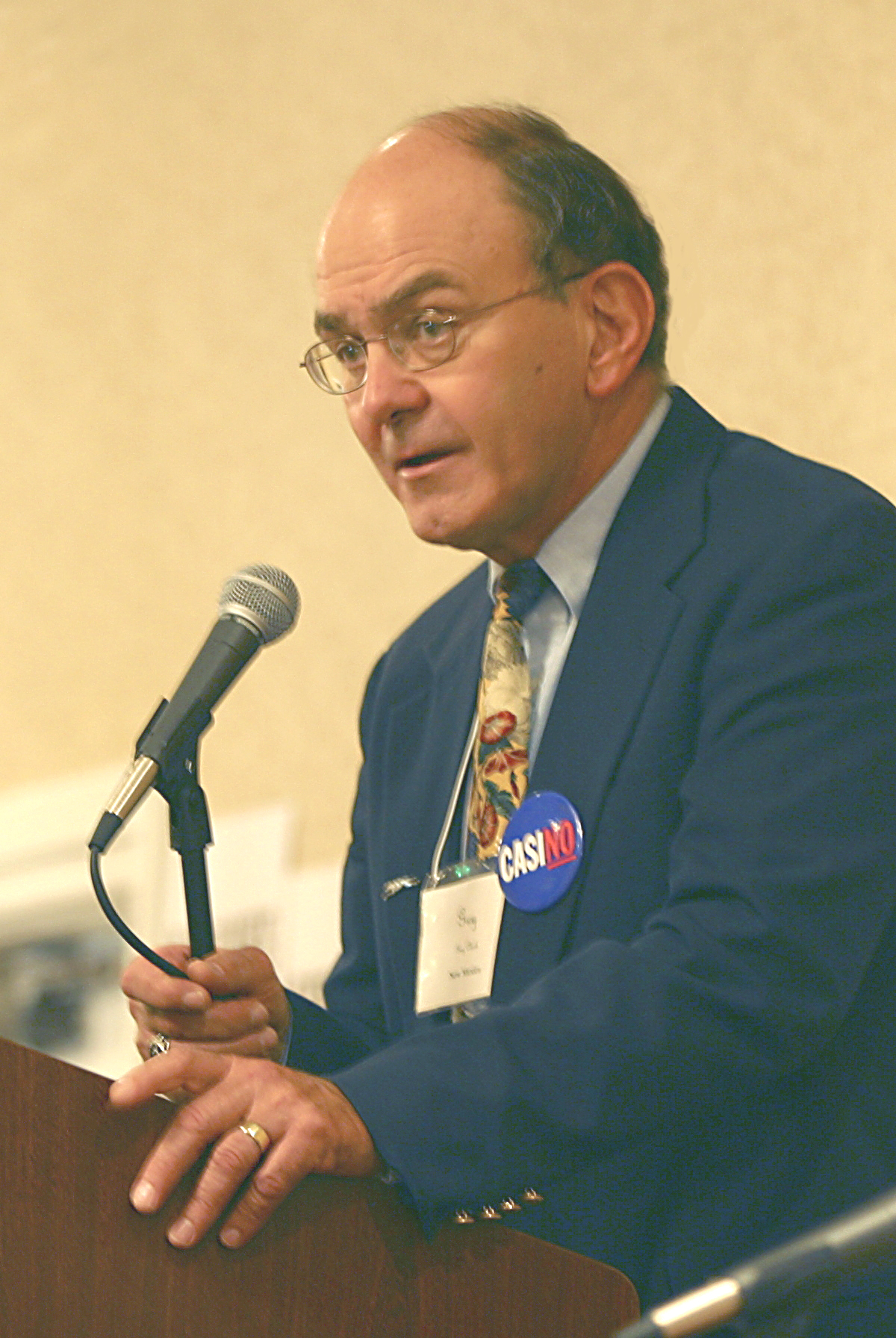
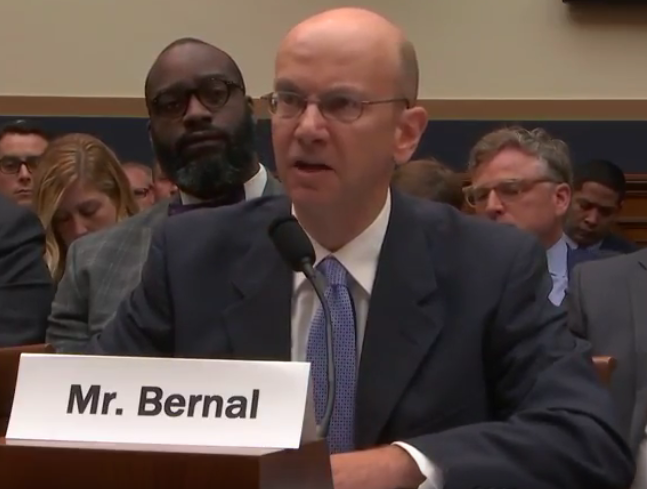
Below is the brief video testimony of Les Bernal, National Director of Stop Predatory Gambling, before the U.S. House Judiciary Subcommittee on Crime and Terrorism’s hearing “Post-PASPA: An Examination of Sports Betting in America” on September 27, 2018. Bernal’s written testimony can be found below the video.
Mr. Chairman, Ranking Member, and members of the Subcommittee, thank you for the opportunity to testify on the topic of sports betting in America.
My name is Les Bernal and I am the National Director of Stop Predatory Gambling, a national government reform network of individuals and organizations from across the United States. I’m also a parent and a former high school and college men’s basketball coach.
Stop Predatory Gambling believes in improving the lives of the American people with compassion and fairness.
We believe everyone should have a fair opportunity to get ahead.
We believe every person’s life has worth and no one is expendable.
We believe state government should not depend on commercialized gambling to fund its activities.
Because of what we stand for, we are one of the most politically diverse organizations in the United States, one in which conservatives and progressives work side-by-side to improve the common good. This reality was evidenced by the amicus brief that Stop Predatory Gambling filed in the Murphy case, co-signed by more than thirty different organizations, including some of the most influential liberal and conservative groups in America.[i]
An Urgent National Problem that Only Federal Action Will Address
Leaders of all political stripes agree that improving opportunity and mobility out of poverty is one of the defining challenges of our time. Around 50 percent of the US population has zero or negative net wealth, meaning their debts equal or exceed their assets.[ii] Yet one major contributing factor to this serious situation has been ignored for too long: Americans are expected to lose $118 billion of their personal wealth to government-sanctioned gambling in 2018.[iii] Many of these citizens suffered life-changing financial losses.
If Congress doesn’t take action to address this problem, then the American people are going to lose more than $1 trillion of wealth to government-sanctioned gambling over the next eight years. Sports betting will make these financial losses even worse.
The reason? The almost sole focus of state-sanctioned gambling has been to maximize government revenues, not to promote and protect the public interest. And nothing suggests sports betting will be any different unless there is strong federal action.
Why Gambling is Different Than Every Other Business or Commodity
There is a faulty assumption surrounding commercialized gambling and it has led to very bad outcomes for the American people. It’s the false perception that gambling is just like any other business. What separates commercialized gambling from every other business, including those involving vices like alcohol and tobacco, is gambling is a big con game. Citizens are conned into thinking they can win money on games that are designed, in the end, to get them fleeced. If you pay for a hamburger, a book, or a glass of wine, that’s what you receive in return. In commercialized gambling, what you receive is the lure you are going to win money. But the game is mathematically stacked against you and inevitably, you’ll lose in the end, especially if you keep gambling.
If you do win some money back, in most cases it comes at the expense and misery of many other people. And an ESPN story recently highlighted that in commercial sports betting, if you try to win, the bookmakers don’t let you place bets anymore.[iv] Bookmakers are severely restricting or closing accounts for the very fact that these people are winning!
“Let People Gamble If They Want,” You May Say
We already have the freedom to gamble. Up to now, many Americans participate in office pools for the Super Bowl, NCAA March Madness brackets, or make casual wagers on the golf course with their friends. These informal events are examples of social gambling.
Social gambling stands in contrast to state-sanctioned gambling, or predatory gambling, that—by design—is much less constrained. It happens when state governments partner with powerful corporate gambling interests to operate and market for-profit gambling to citizens and their communities.
In state-sanctioned gambling, there is a “house” skimming a large profit. It’s exempt from truth-in-advertising laws, giving states and gambling corporations wide latitude to market gambling, grossly exaggerate chances of winning and aggressively lure citizens to gamble away bigger sums of their cash. People often borrow money to participate. It goes on all day, every day of the week, year round. And it requires the majority of Americans who rarely gamble to subsidize the scheme with their own cash, footing the bill for the steep social costs and state budget problems it leaves behind.
One can be a libertarian on this, while at the same time, believing that we cross an unacceptable ethical line when we go from allowing individuals to gamble to allowing our government to set up a massive marketing and distribution scheme urging people to do so. Making a bet with a friend, that’s one thing, but if you do it against a sportsbook, you’re going to lose money all the time.
Illegal Gambling Tends to Increase When States Legalize Gambling
The primary source of information for the size and scope of illegal sports gambling in the U.S. has been the American Gaming Association, the national lobbying organization for gambling operators who have a vested financial interest in seeing commercialized gambling metastasize.
When gambling operators call for “regulation,” what they really mean is government granting monopolies and awarding regulatory advantages to favored firms.
Presently in the U.S., no illegal gambling operator is putting liens on the homes of citizens to collect gambling losses, like legal operators do. No illegal operator sends free gambling wagers by direct mail to your house to lure you back to the local casino, like legal operators do. No illegal operator is pushing $50 lottery scratch tickets, seven days a week, in economically-depressed communities, like state lotteries do. No illegal operators are running gambling ads during live broadcasts of sporting events with such intensity that one out of every five ads is to place a bet, which is what some of the legal sports gambling operators maneuvering here in the U.S. do in places like the United Kingdom.[v] No illegal operator is sponsoring pro sports teams, which involves team uniforms emblazoned with the names of gambling companies on them; stadium and arena surfaces where continuous gambling ads surround the game itself; and pre-match and post-match interviews, like the legal operators do in the U.K.[vi]
If the illegal sports gambling operators supposedly cannot be controlled right now, as the big commercial gambling operators claim, then how can you control and regulate the gambling operators you license? If you can’t shut down the illegal sports gambling operators now, how would you possibly shut down licensed operators who don’t follow the rules?
There are a number of other reasons why illegal gambling tends to increase when states sanction gambling. These include:
- Untaxed illegal operators can offer better odds and tax avoidance that legal operations cannot.
- Once gamblers start betting legally, they become less averse to gambling in unlicensed venues and websites.
- Law enforcement in gambling states view illegal gambling as a state revenue issue rather than a criminal activity, making enforcement less of a priority.
Commercialized Sports Betting Severely Harms Kids and Will Radically Change the Way That Kids Consume Sports
Studies show that children in those countries with legal sports gambling are repeatedly exposed to harmful messages and advertisements about sports gambling.[vii] The frequency of sports gambling ads normalizes gambling for kids.[viii] These kids come to see gambling as central to playing and watching sports.[ix] Rather than talking about their favorite team, they talk about the odds of their team winning.
The younger children start gambling, the more likely it is they will become habitual and problem gamblers, regardless whether they are from an urban or a suburban community.[x]
Researchers at Johns Hopkins’ Bloomberg School of Public Health have published nearly a dozen papers on Baltimore youths and gambling.[xi] They found a strong link between gambling and other problems among the city’s youth. Other studies in the Johns Hopkins’ series found that gambling often leads to depression, crime, homelessness and joblessness in young adulthood.[xii]
When you talk about sports gambling in 2018, it means gambling on almost any kind of contest you can imagine:
- In-play betting;
- Betting on video games or eSports;
- Betting on pop culture TV programs like The Bachelor and The Oscars;
- And much of it is happening online in the form of online gambling.
Can you imagine allowing young people to gamble on video games? That’s where gambling operators, and their partners in state government, are leading this country unless Congress acts.
For the Majority of Americans Who Don’t Gamble, You Pay Even If You Don’t Play
Gambling lobbyists and some public officials continue to tout government-sanctioned gambling as a way to raise tax revenue. But history has shown repeatedly that this argument is either overstated or wrong. A 2016 national report by The Rockefeller Institute at SUNY-Albany found that while states creating new revenue streams from gambling may see momentary bumps in tax income, “the revenue returns deteriorate—and often quickly.”[xiii]
Beyond its obvious status as a budgetary shell game, government-sanctioned gambling incurs major social costs that end up being footed by all taxpayers. In addition to targeting and exploiting the financially desperate and cultivating addiction,[xiv] [xv] government-sanctioned gambling leads to increases in rates of personal bankruptcy and provides new avenues for crime and money laundering.[xvi] [xvii] Gambling operators don’t pay for the harms they cause families, businesses, and communities. Taxpayers do.
All the citizens who don’t gamble also pay another way. Government-sanctioned gambling lowers our national standard of living because it’s a sterile transfer of money from millions of ordinary people’s pockets into a small number of other people’s pockets, producing nothing new and nothing of lasting value. Its economic impact is similar to throwing your money on the street so someone else can pick it up – it redistributes wealth without creating it. Because this nonproductive activity nevertheless uses up time and resources, we experience a reduced national standard of living, a consequence that impacts all of us.
CONCLUSION
State governments are often called laboratories of democracy. But over the last 30 years, the record is clear: when it comes to gambling policy, states are laboratories of fraud, exploitation and budgetary shell games.
Without Congressional action, the American people are on a collision course to lose more than $1 trillion of wealth to government-sanctioned gambling over the next eight years. Widespread commercialized sports betting will make these financial losses even worse.
Public officials and opinion leaders who profess a desire to improve opportunity and alleviate poverty often lament how few levers they have to pull. Priority one needs to be to stop turning millions of people who are small earners, who could be small savers, into habitual bettors.
SOURCES
[i] Stop Predatory Gambling amicus brief in Supreme Court case Murphy vs NCAA, https://www.stoppredatorygambling.org/stop-predatory-gamblings-amicus-brief-for-the-us-supreme-court-case-christie-vs-ncaa/
[ii] The Quarterly Journal of Economics, Emmanuel Saez and Gabriel Zucman, Vol. 1, May 2016, Issue 2, Wealth Inequality in the United States Since 1913: Evidence from Capitalized Income Tax Data, Pg. 554. http://gabriel-zucman.eu/files/SaezZucman2016QJE.pdf
[iii] “This is how much Americans lost on state-sanctioned gambling last year,” Quentin Fottrell of MarketWatch, published by Dow Jones Media, May 15, 2018. https://www.marketwatch.com/story/this-is-how-much-americans-lost-on-state-sanctioned-gambling-last-year-2018-05-15
[iv] “Won and done? Sportsbooks banning the smart money,” David Purdum of ESPN, August 30, 2018 http://www.espn.com/chalk/story/_/id/24425026/gambling-bookmakers-growing-us-legal-betting-market-allowed-ban-bettors
[v] “Gambling adverts ‘in 95% of TV matches’,” BBC News, Oct. 23, 2017, http://www.bbc.com/news/business-41693866
[vi] Ibid.
[vii] Hannah Pitt et al., “It’s just everywhere!” Children and parents discuss the marketing of sports wagering in Australia,” Australian and New Zealand Journal of Public Health, 480, 485 (Oct. 2016) https://www.ncbi.nlm.nih.gov/pubmed/27524502
[viii] Ibid.
[ix] Sally Monaghan, et al, “Impact of gambling advertisements and marketing on children and adolescents,” McGill University and Univ. of Sydney, Journal of Gambling Issues: Issue 22, December 2008 http://youthgambling.mcgill.ca/en/PDF/Publications/2008/Monaghan Derevensky Sklar.pdf
[x] “The Dangers of Youth Gambling Addiction,” New York Council on Problem Gambling, Know the Odds http://knowtheodds.org/wp-content/uploads/2013/05/NYCPG_ebook_YouthGambling_052114.pdf
[xi] “Disadvantaged urban youth may be more likely to be problem gamblers: Link found between gambling, other abuses among Baltimore’s youth,” The Baltimore Sun, April 18, 2014 http://articles.baltimoresun.com/2014-04-18/health/bs-hs-youth-gambling-20140418_1_problem-gamblers-gambling-problems-las-vegas-style
[xii] Ibid.
[xiii] Lucy Dadayan, State Revenues from Gambling: Short-Term Relief, Long-Term Disappointment, The Nelson A. Rockefeller Institute of Government (2016), http://www.rockinst.org/pdf/government_finance/2016-04-12-Blinken_Report_Three.pdf
[xiv] Cornell Univ. Professor David Just, “The big swindle: In lotteries, the poor are the biggest losers,” CNN, Dec. 18, 2013https://www.cnn.com/2013/12/18/opinion/lottery-poor-just-opinion/index.html
[xv] John Rosengren, “How Casinos Enable Gambling Addicts,” The Atlantic (Dec. 2016) https://www.theatlantic.com/magazine/archive/2016/12/losing-it-all/505814/
[xvi] Social Costs of Problem Gambling, Problem Gambling Research and Intervention Project, Georgia State University, https://goo.gl/kcgQv2
[xvii] Dr. Earl Grinols and Dr. David Mustard, MIT Press, Review of Economics and Statistics, Feb. 2006, https://www.mitpressjournals.org/doi/abs/10.1162/rest.2006.88.1.28?journalCode=rest